
Haint Blue

Coming from Chicago, I can safely say I’ve never heard of the color Haint Blue. Well actually, it’s not a specific color, rather it’s a hue or a shade of color. I think. Regardless, I am obsessed with it. Take a sweet little robin’s egg and blend it with the iconic Tiffany blue box, and that’s haint blue. Plus, it’s rich with history from the Spring Island region – and a goal of ours has been to incorporate regional touches into the home.

Haint blue was originally derived from the region’s indigo plants. The Gullah Geechee, the African slaves who farmed the crops, believed that this light shade of blue dye that came from the indigo plants helped ward off evil spirits, known as “haints”. The thought was that the beautiful blue would be seen as water (which haints could not cross) or the sky (which would lead the haints far away from the Gullah). Thus the color was used to paint ceilings and walls.

After reading this history, and seeing the pure beauty of the color, I am sold. Question is – WHICH SHADE? and WHERE TO USE IT ON THE HOUSE? Here’s a bit more information on how some of the pros use haint blue.

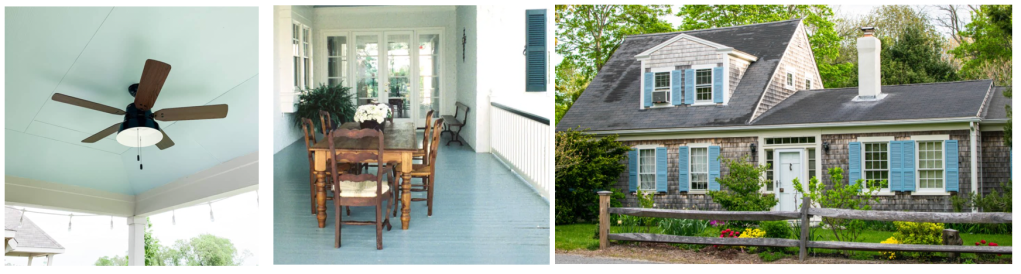
The possibilities seem endless, don’t they? Any favorites?

First step – build the team.

TEAM MEMBER #1 = THE ARCHITECT. Working with an architect is an exercise in collaboration. It’s a bit like dating. They need to get to know you, and you need to get to know them. Finding the right fit isn’t automatic. Multiple considerations have to be taken into account — overarching design philosophy, working methodology, familiarity with Spring Island, availability, and on and on. At the end of exhaustive interviews and recommendation vetting, for me anyway, it came down to gut instinct. Knowing that I was going to be deeply involved meant that I had to enjoy working with and trust the team we selected. (And Todd had to agree!)

We began working with the Court Atkins Group early in 2021. They’ve been terrific – inspiring, collaborative and exciting all wrapped together. After listening to our wishlist, visions and concerns they have given us something that we feel is not only original and fresh, but that also checks all of the boxes we needed to check.

I’ve been in the architecture, design and real estate arena for just long enough to know enough to be annoying. It means I ask too many questions, and can make arriving at simple solutions feel exhausting. Court Atkins has put forth just the right blend of patience and integrity to get us across the finish line with an amazing set of plans.

Photo by Lex Photography on Pexels.com

How It All Started

The genesis of this project goes back to the COVID lockdowns of 2020. After months of isolation, Todd and I took a quiet road trip down to the SE, mainly to escape the long Chicago winters. We explored parts of North Carolina, and then headed towards Charleston and the South Carolina coast. We had been introduced to Spring Island by friends, and decided to drive through it again.

The deeper onto the island we drove, the stronger the appeal became. I knew nothing about this part of the US, but Todd, having grown up in Atlanta and Tennessee, felt a strong pull. It certainly was not the Midwest, nor was it Florida, nor was it the Caribbean – all places I was familiar with. Somehow it was that very fact – that I knew nothing about lowcountry and the southeast, that seemed to draw me in further. At this very scary time in the world, and at a transitional time in our own lives, the allure of pushing myself outside my comfort zone seemed very energizing.

Long story short, we dug deeper into what Spring Island had to offer and what was available, and we feel lucky to have found an ideal piece of property on which we could build the next chapter of our lives.

“Tell me about Spring Island ….”

I get this question so often and it is still a difficult one to answer. A few obvious answers: Spring Island is nestled geographically between the towns of Charleston and Beaufort, South Carolina to the north, and Savannah, Georgia to the south. So plenty of “city” opportunities are easily accessible. It sits on the Port Royal Sound – the deepest natural harbor in the Southeast and is bordered by the tidal creeks of the Chechessee and the Callawassie rivers. Spring Island is roughly 3,000 acres (small!) with about 400 homesites. Here’s a great overview of Spring Island’s history.

A huge appeal of Spring for me is the blend of physical and intellectual activities offered. To keep my aging body moving there is a super cool golf course on the island — Old Tabby Links — said to be one of Arnold Palmer’s finest designs. Yes, I plan on playing this course relentlessly; stay tuned for updates. Tennis, croquet, pickleball, horseback riding, hiking, birding, fishing … the list goes on.

Then, to keep the brain pumping there is an equally impressive list to choose from. A brand new Art Barn offers classes, lectures and studio opportunities for everything from painting through photography. The Club brings in live theatrical and musical performances regularly. The Trust hosts nationally recognized scholars on a bevy to topics. Residents are encouraged to “Be Humble. Be Teachable.” Music to my ears.

All of this is set on island whose residents share a collective mission to preserve the natural surroundings so that they can be continually enjoyed. (The word “continually” used to be mean “by future generations”.) One third of the island is set aside as a natural preserve. The magnificent live oaks are surrounded by endless floral and fauna. I know next to nothing about birds, wildlife and sea creatures but I do know they are wondrous and that I am lucky to get a chance to learn from them and about them. A 6+ acre community farm grows over 30,000 plants in the summer with residents encouraged to engage in the upkeep as well as the fruits of it all. A true “farm to table” experience right in our backyards. I have a feeling that my midwest-Chicago-suburban bubble is about to be popped!